A Product Review of the Soft Touch Ergonomic Crochet Hooks by Clover
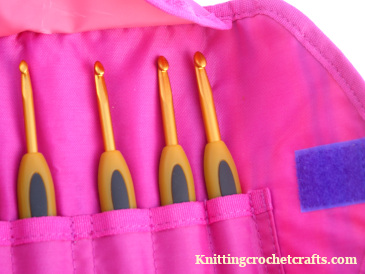
I bought my first set of Clover Soft Touch crochet hooks around 2009ish, and I’ve been using the same set ever since then. So, sometime in 2026, It’ll be 17 years that I’ve owned and used these hooks.
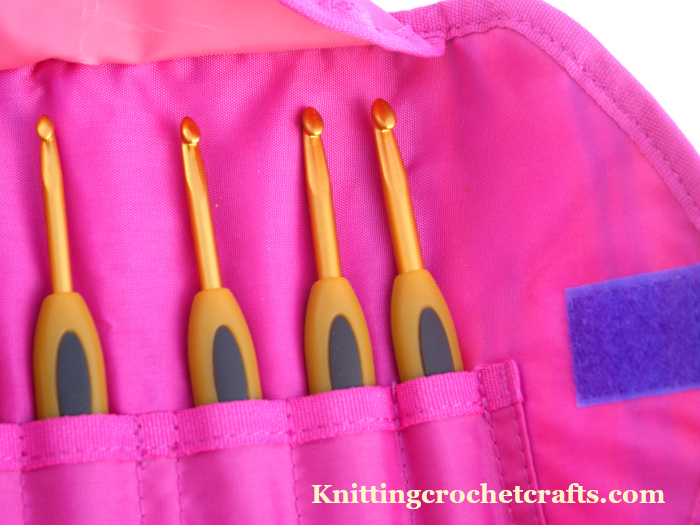
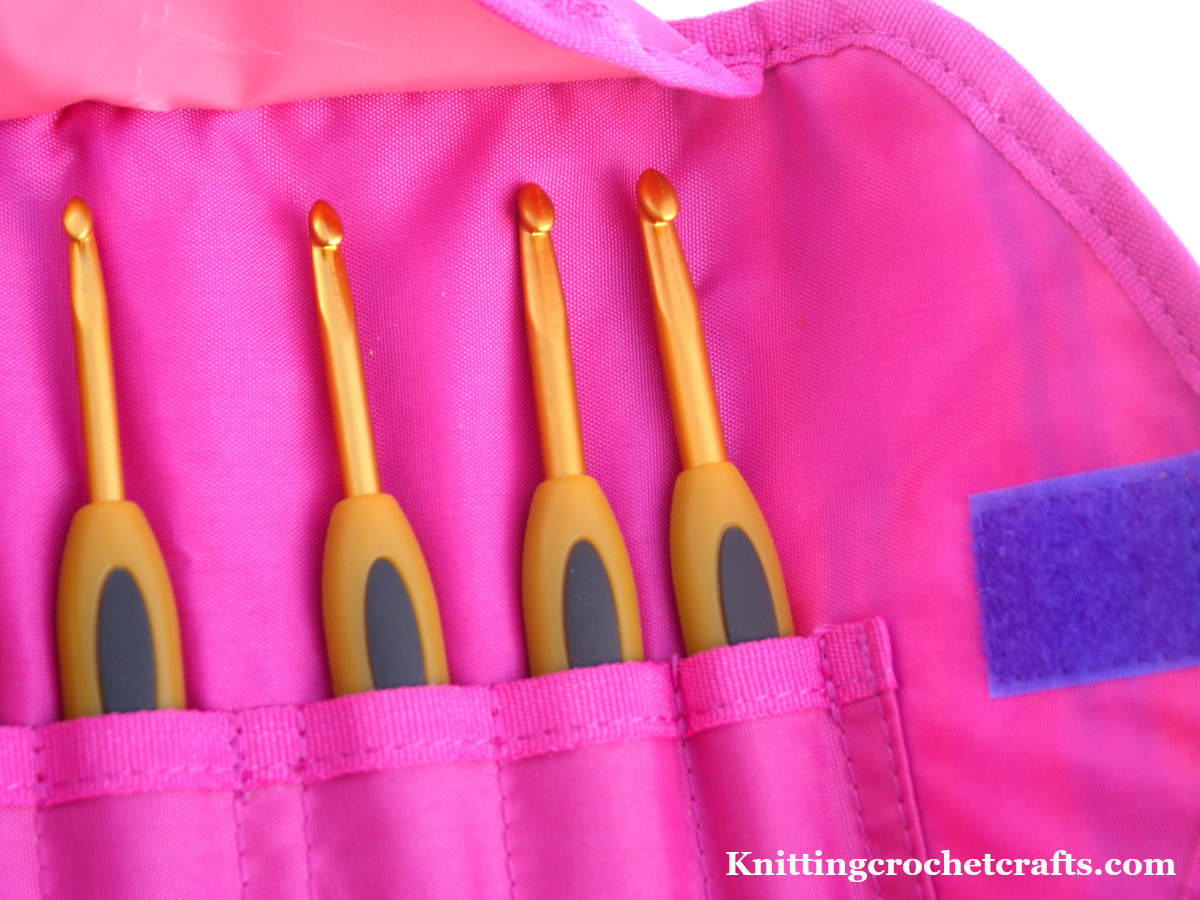
(I took the photo above on 12-4-2009 when the hooks were still brand new.)
My Clover Soft Touch crochet hooks still look almost exactly like they did when I first bought them; they have aged very, very well, with few obvious signs of wear, despite having endured a massive amount of abuse.
Here’s a photo I took of hooks from the same exact set on 12-15-2025:
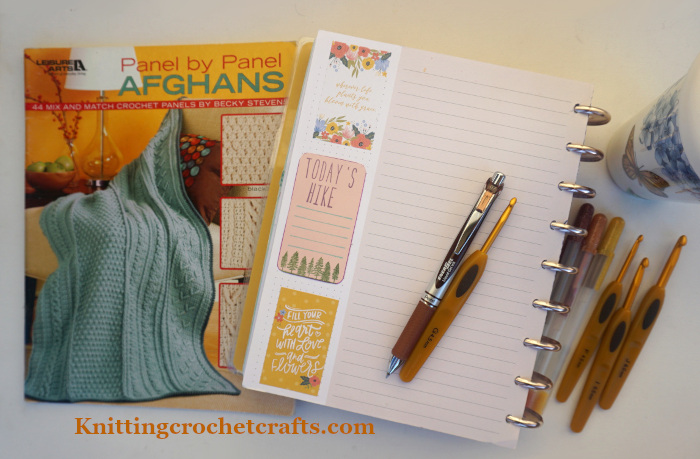
I was a liveaboard cruising sailor for about 5 years — and in that time, these hooks sailed up and down the Pacific coast with me; then they crossed the Atlantic Ocean and the Mediterranean Sea, first in one direction and then going back in the other direction.
I had a lot of things break during our ocean voyages, but these hooks didn’t break. While I can’t promise you they’re totally indestructible, I can honestly say they are extremely durable.
I can’t, however, say the same for the cloth crochet hook organizer that my Clover Soft Touch crochet hook set was originally packaged with. The organizer was really pretty, but the stitching on it was not very durable. The stitching tore, and the fabric frayed, within the first couple of weeks I owned it, before I even had a chance to move aboard the sailboat and go sailing.
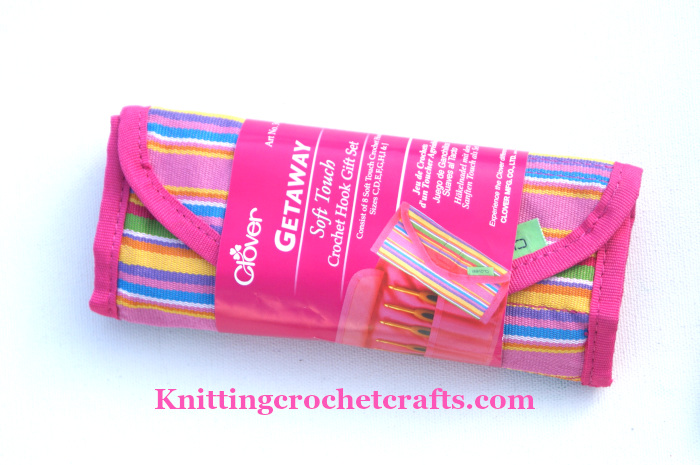
But these days, I don’t see anyone offering that same set of Clover Soft Touch crochet hooks I originally purchased, the set that came with the pink striped organizer.
Matter of fact, I just went looking for Clover Soft Touch crochet hook sets, but I couldn’t find anyone selling genuine sets of these crochet hooks.
(Beware, because some of the people selling these hooks in sets on Amazon are selling knockoffs that look like Clover’s hooks, but aren’t).
The reputable craft stores where I like to shop are now offering these crochet hooks individually.
Clover’s Soft Touch crochet hooks were the first ergonomic crochet hooks I ever bought — and I loved them.
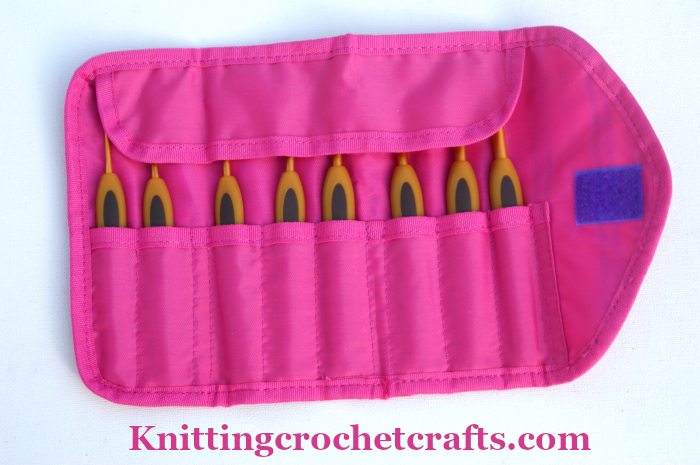
I still love them now, and I still use them; but these aren’t the only brand I use. They have pros and cons, which I will explain in more detail.
Before I bought my first set of them, I was using no-frills aluminum Boye hooks.
(And I still sometimes use old school aluminum Boye crochet hooks, but nowadays I use those old Boyes much less often than I used to.)
These are much better than Boyes, which I have a lot of experience using — but they might not be right for you, depending on your circumstances. So keep reading if you want a detailed comparison of these two hook brands — and also a comparison of how Soft Touch crochet hooks compare against other crochet hook brands.
All the Details You Need to Know About Soft Touch Crochet Hooks:
Shape of the Hook: Soft Touch crochet hooks have tapered hooks.
Hook Material: aluminum (smaller-sized steel hooks are also available, but I don’t have those in my stash to review; So I’m only reviewing the aluminum sizes.)
Handle Material: ABS resin (plastic)
Length of the Entire Crochet Hook and Its Components: Clover Soft Touch crochet hooks each measure about 5.25″ long, with the metal tips measuring about 1.5”. The handle length on a Clover Soft Touch crochet hook is about 3.75”.
The Best Things About Soft Touch Crochet Hooks by Clover (Pros):
- Ergonomic and comfortable to hold, even if you crochet all day, for hours on end
- Very sturdy; I’ve never had one break, and I’m abusive toward crochet hooks. Mine have been subjected to heavy use and ocean crossings in a sailboat, and they’ve lasted for 16+ years (and counting!)
- Some brands of crochet hook are prone to bending, and a bent crochet hook might be to blame when you experience yarn splitting (people often blame the yarn, but splitting isn’t always the yarn’s fault). These hooks are very unlikely to bend, which means that you are a lot less likely to experience split yarn when you use them.
Things That May Disappoint You About Soft Touch Crochet Hooks by Clover (Cons):
- No Color Choices: Some competing brands of crochet hooks come in different colors, which can help you easily differentiate between your hooks, just by glancing at them.
However, you will not have that advantage with Clover Soft Touch crochet hooks, which are all the same color — a lovely “Harvest Gold” color that is reminiscent of the 1970s. If you’re a Gen Xer who fondly remembers the 1970s, you might get a case of the “warm fuzzies” every time you look at your Harvest Gold hooks. But, it’s also possible that you might not like this color, which would be a real bummer. - Relatively Expensive: Although Clover Soft Touch crochet hooks are not the most expensive hooks on the market, the upfront cost of these hooks is high enough that some crocheters might be reluctant to spend the money on these.
But here’s the thing you have to keep in mind when you decide whether you want to invest in these hooks: Cheaper alternatives are likely to bend or break in the long run, and will need to be replaced. So you have to factor replacement costs for future hooks into your buying decision. This is especially true for the smaller sized hooks like Cs, Ds and Es (It’s far less likely that you’ll bend a metal J or a K while you’re crocheting). You’d think metal Boyes would be indestructible, but they aren’t; they bend, if you are rough on them (I am), and once bent, they need to be replaced, or you will waste a lot of time and money splitting your yarn.
So even if you’re on a super tight budget, you might find that Clover Soft Touch hooks are a better investment than cheaper, junkier, lower-quality hooks. But this is really a personal decision.
Other Things to Be Aware of Before You Buy These Hooks
The name “Soft Touch” is a little bit misleading, because you might think that the hooks are actually soft to the touch. They are not.
The handles are not squishy or soft in any way. They are made of ABS resin, which is a hard plastic. The hooks are made of aluminum. There’s nothing soft here.
So why the name? Beats me. It’s a mystery!
Soft Touch Crochet Hooks by Clover Versus Susan Bates Bamboo Handle Crochet Hooks
- Susan Bates Bamboo Handle crochet hooks have inline hooks; in comparison, these hooks are tapered .
- Susan Bates Bamboo Handle crochet hooks and Clover Soft Touch crochet hooks both have aluminum tips.
- Susan Bates Bamboo Handle crochet hooks have handles made of bamboo; the handles on these hooks are made of ABS resin (plastic).
- Susan Bates Bamboo Handle crochet hooks each have an ergonomic handle, and the thumb rest lies on the metal part of the hook. There is a distinctive indentation for the thumb rest, and it has the same disadvantage that regular aluminum (Silvalume) hooks have; the hook’s identifying information is engraved in the metal. If you crochet all day, or at least for hours on end, you can end up with soreness where the metal rubs against your thumb.
In comparison, the Clover Soft Touch crochet hooks do not have an indented thumb grip, and the portion of the hook where your thumb rests is totally smooth. - Susan Bates Bamboo Handle crochet hooks seem to slightly differ in their dimensions, with their tips and handles not all being precisely the same size. The aluminum tips are each in the ballpark of about 2.5”, and the bamboo handle length can apparently range from approximately 3.25” to 3.375,” judging from the measurements on these hooks that I have in my collection. The total length ends up being around 6” total, give or take about a quarter of an inch.
In comparison, Clover Soft Touch crochet hooks measure 5.25″ long and have handles measuring about 3.75” long.
Soft Touch Crochet Hooks by Clover Versus Susan Bates Silvalume Aluminum Crochet Hooks
- Susan Bates Silvalume crochet hooks have inline hooks; in comparison, these hooks are tapered .
- Susan Bates Silvalume crochet hooks are made entirely of aluminum, including tips and handles; these crochet hooks have aluminum tips, but resin handles.
- Susan Bates Silvalume crochet hooks do not have ergonomic handles, and the there’s a distinctive indentation on the handle where the thumb is supposed to rest. The thumb grip has the hook’s identifying information engraved onto it. For that reason, I wouldn’t recommend Susan Bates Silvalume crochet hooks to autistic crocheters who experience sensory issues – or, for that matter, to any crocheters who routinely experience sensory issues. This issue is not as likely to bother neurotypical crocheters except in cases where you’re crocheting for many hours on end; at some point, any crocheter’s thumb will get sore after many hours of rubbing against the metal writing on the thumb rest.
In comparison, there isn’t a separate, indented thumb grip on the Soft Touch crochet hooks; the handle is smooth. - The Susan Bates Silvalume crochet hooks I have in my stash each measure about 5.5”. (I’m not sure if this is typical for the entire brand across their entire history.)
In comparison, these Soft Touch crochet hooks measure about 5.25″ long.
Soft Touch Crochet Hooks by Clover Versus Boye Aluminum Crochet Hooks
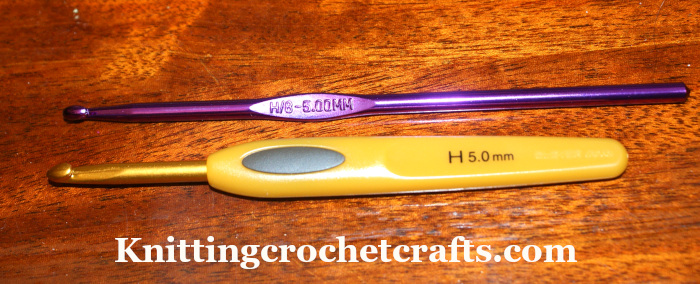
Clover’s Soft Touch crochet hooks are an upgrade over old-fashioned aluminum Boye hooks.
If you’re a longtime Boye hook user with petite hands, it’s likely that you’d be able to make an effortless transition to using Clover Soft Touch hooks. If that’s your situation, I recommend giving Soft Touch hooks a try to see if they’d work well for you.
If your hands are larger than average, switching from Boye to Soft Touch might or might not be a comfortable transition. Some people with large hands cannot comfortably switch between these two hook brands, because Soft Touch hooks are shorter than Boye hooks. This might make a difference to you, depending on how you crochet. So if you have large hands, please be cautious; you might not want to buy new hooks in every size at first, until you’ve had a chance to determine whether you like this style of crochet hook. Or you might just want to consider a different brand of crochet hook than Soft Touch.
Here’s a detailed comparison between Boye hooks and Clover Soft Touch hooks:
Both my stitch gauge and my row gauge are dramatically different when when I use Boye vs Clover hooks.
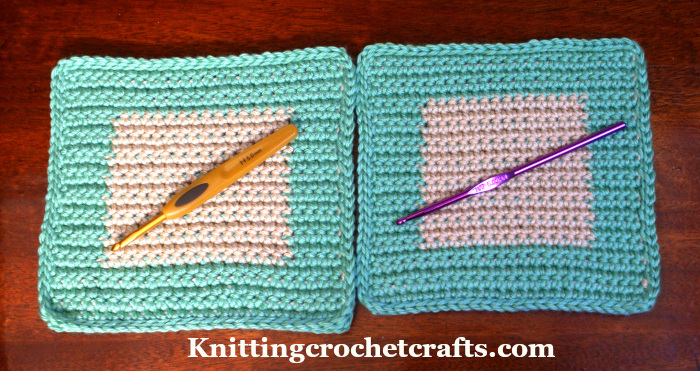
Therefore, these hooks cannot be used interchangeably.
If you’ve already started a project with one of these hooks, DO NOT switch to using the other brand’s hook mid-project; switching could make a huge problem for you.
But, having both of these hooks could possibly be helpful, because there might be times when you can’t get the right gauge with one of them, but you can get the right gauge with the other one.
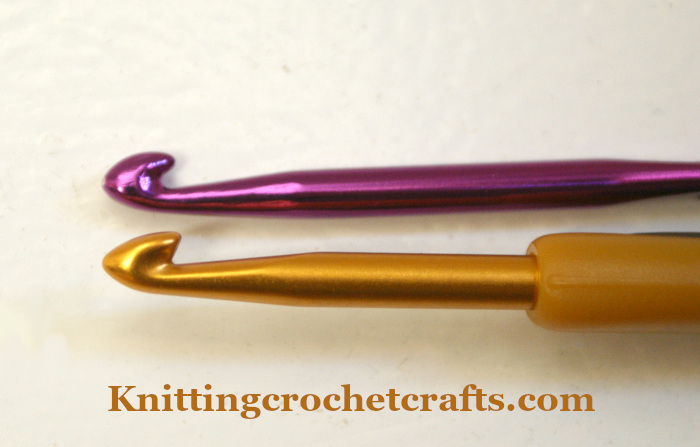
Boye aluminum crochet hooks have tapered hooks that are a nice compromise between blunted and pointy; Soft Touch hooks also have tapered hooks that are not too blunt, but the hooks are ever so slightly pointier.
Beyond that, if you study the above photo closely, you can see that there are other slight differences in the amount of tapering and the angle at which these hooks grab yarn.
You wouldn’t think these teensy, almost negligible differences would have any effect, would you?
But they do!
Check this out:
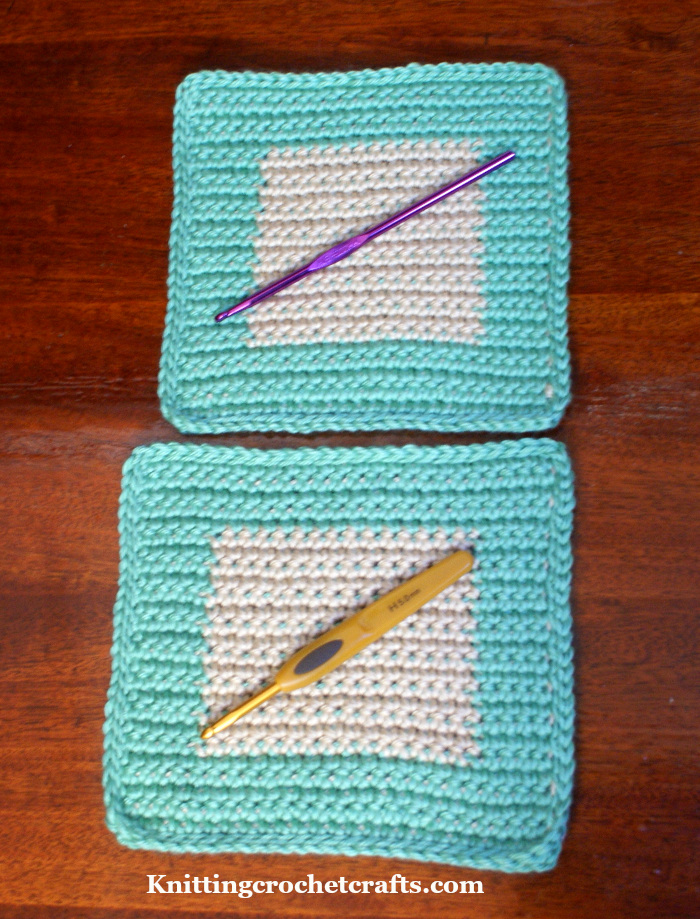
I crocheted both of these squares using the same skeins of yarn, on the same day, using the same exact pattern. The only difference: I crocheted one of them with my Boye size H crochet hook and the other one with my Clover Soft Touch size H crochet hook. You can see that there is a noticeable and dramatic difference in how the squares turned out.
More Differences Between Boye and Clover Soft Touch Crochet Hooks:
- Except for the smaller, thinner steel crochet hooks that need to be stronger, Boye crochet hooks are made entirely of aluminum, including the tips and the handles; in comparison, these Soft Touch crochet hooks have aluminum tips. The handles on the Soft Touch hooks are made of ABS resin (plastic).
- Boye’s aluminum crochet hooks do not have ergonomic handles, and the there’s a distinctive indentation on the handle where the thumb is supposed to rest. The thumb grip has the hook’s identifying information engraved onto it. For that reason, I wouldn’t recommend Boye crochet hooks to autistic crocheters who experience sensory issues – or, for that matter, to any crocheters who routinely experience sensory issues.
This issue is not as likely to bother neurotypical crocheters except in cases where you’re crocheting for many hours on end; at some point, any crocheter’s thumb will get sore after many hours of rubbing against the metal writing on the thumb rest.
In comparison, there isn’t a distinctive indentation on the Soft Touch crochet hooks where a thumb rest would typically be. Clover Soft Touch crochet hooks each have an ergonomic handle, and the handles are smooth and comfortable. I think this is a huge improvement, but this is a matter of personal preference. - The Boye crochet hooks I have in my stash each measure in the ballpark of about 6”. This holds true for both my vintage and newer Boye hooks.
In comparison, these Soft Touch crochet hooks measure about 5.25″ long. That’s a significant difference. I have petite hands, and for me, both hook lengths are workable; but if you have large hands or long fingers, you might find that the Clover hooks are just too short for your liking.
Soft Touch Crochet Hooks by Clover Versus Knit Picks Dot Crochet Hooks
Here’s a brief comparison between Soft Touch crochet hooks and Dots crochet hooks:
- Dots crochet hooks have semi rounded tapered hooks; Soft Touch crochet hooks are similarly tapered .
- Dots and Soft Touch crochet hooks both have aluminum tips.
- Dots crochet hooks have plastic handles, and the handles on Soft Touch hooks are made of plastic resin. There are several significant differences between the two; one of the most important differences is in the handle length, with the Dots handle being longer, at 4.75″. Soft Touch handles only measure about 3.75”.
- Dots crochet hooks each have a triangular thumb grip; there isn’t a comparable thumb grip on the Soft Touch hooks.
- Dots hooks measure 6.5″ long. In comparison, Soft Touch hooks only measure about 5.25″ long.
Conclusion:
I enthusiastically recommend the Clover Soft Touch crochet hooks to most crocheters — the exception being that I don’t recommend them to crocheters who have very large hands, very long fingers or a strong preference for longer crochet hooks.
I especially recommend these hooks to autistic crocheters or any crocheters who experience sensory issues, because the smoothness of these hooks’ handles and the lack of metal engraving on the thumb grip area are ideal for people in that situation.
Where to Buy Soft Touch Crochet Hooks by Clover
- Click here to shop for these crochet hooks at a Cherry on Top Craft Shop.
- Click here to shop for these crochet hooks at Knit Picks.
Thanks for checking out this review of Clover ‘s Soft Touch crochet hooks. I appreciate your interest!
If you enjoy crocheting, I invite you to return to this site often; I don’t want you to miss out on seeing future yarn reviews, crochet patterns, craft tutorials, project ideas and inspiration!
You can make sure you don’t lose track of this site by signing up for my newsletter and community at Substack.
Basic subscriptions are free; I send out regular newsletters to let my subscribers know about new craft articles and tutorials as they are posted. I also share details about the craft projects I’m working on, and invite my readers to share their projects, too. So there is no need to feel like it’s just you, crafting all alone at home. I’d love to have you join us! You’re invited!!
By Amy Solovay
Please Visit My Ko-Fi Shop HERE to Find My Sample Sale, Destash Sale and Digital PDF Pattern Downloads for Sale.

Please Visit My Ravelry Store HERE to Find Digital PDF Pattern Downloads for Sale.
About Your Product Reviewer:

Amy Solovay is a real, live, human content creator and educator who holds an Associate of Arts degree in Textile Design from FIDM LA (The Fashion Institute of Design and Merchandising, Los Angeles) and a Bachelor of Arts degree in mathematics from Sweet Briar College. She is NOT a robot and does not use artificial intelligence (AI) to write book reviews or articles for this website.
Amy learned to hand knit as a teenager, and she learned to machine knit in design school at FIDM. After graduation, she worked in the textile industry as a professional knit designer. She still enjoys hand knitting all these years later.
As an educator, Amy Solovay used to teach in-person college courses in trend forecasting, marketing and surface design at California Design College in Los Angeles. Nowadays she uses online platforms for sharing her knowledge about textiles, crafts, current color trends and current design trends.
Learn More About Crochet Hooks:
- Learn How to Hold a Crochet Hook in This Beginner’s Guide to Crochet
- What Is Your Favorite Crochet Hook?
This page was last updated on 12-23-2025.